
[ಕನ್ನಡ ಅನುವಾದ ಶೀಘ್ರದಲ್ಲೇ ಬರಲಿದೆ — Kannada translation coming soon]
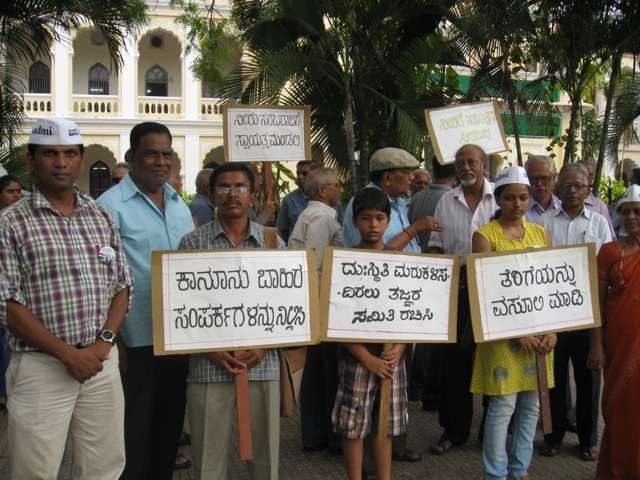
Protest to implement water sector reform to prevent future crisis. Mysoreans may be participating in more than 100 public protests of one kind or the other every year. Protests are held by various NGOs to promote their mission. Some protests are held by small ad hoc citizens ‘groups for publicizing their causes. Dominant and highly publicized protests are by the political parties. These are mostly to show strengths of different political parties. But their claimed objective is to protest the policies of the government. The real reason is to demonstrate the capabilities of individual leaders in organizing protests. They think such protests will improve their chances of getting tickets to contest in the elections. It is high time we start questioning the need to hold protests by NGOs in a democracy. As far as protests by the political parties, they will continue. Only when political parties change their selection criteria these protests may stop. I must have participated in more than 50 protests over the last 24 years as a member of MGP. The very first protest in 1989 was to urge the government to remove lead out of petrol. By 1989, petrol sold was lead free in most of the developed world. It was a well recognized fact that the lead emissions gave rise to mental retardation and it was a serious problem. MGP had distributed more than 25000 pamphlets. News papers had given wide coverage. However on the date of protest there were just five protestors. Thus the first protest did not have any impact. But after few years the government decided to restrict lead in petrol and it had nothing to do with MGP protest.
MGP along with its sister organization Parisar, had organized a mammoth protest to save environment in association with the government authorities. More than 10000 school students participated. At that time it must have set a new record of involving the student participation to create awareness concerning environmental protection among the students. These students are adults today. However, look at the way we are taking care of trees in the city (forget planting them), or handling garbage (we are drowning in garbage), non-use of plastic (very few take their own bags while shopping) conserving water, energy, etc, it is doubtful that our efforts have paid off. Yet another major protest MGP has been involved over the years is to save People’s Park. As recently as a year back, about eight hundreds had assembled (we expected more than five thousands) in People’s Park to put pressure on the government to drop their library project. Though the Karnataka Parks and Open Spaces act prohibits construction of any building (permits only a small building for storing park equipments), the government is determined to build a library there. Right now because of a case filed by Revathi Enterprises, (the contractor who had won the earlier contract) in Karnataka High Court, the construction work has stopped, while park is deteriorating. What did we achieve by holding a protest? Few days back, MGP organized a protest to demand few basic reforms in water sector to avoid future water crisis. In a city where just about everyone has suffered because of water scarcity, we expected, more than 10000 would participate in the protest. However, there were about 50 participants! MGP did have few successes in securing its objectives like when it had organized protests against construction of an office/residence in Cheluvamba Park, saving Kukkerhalli and Lingambudhi lakes, location of Police Bhavan, etc. When MGP had successes it was often because of its PILs and not the enthusiastic support by Mysoreans. Most may be thinking like in Tennali Rama’s story that others will pour milk and they can get away by pouring water. Or they seem to believe in free lunch. They assume that ”there are these NGOs who have no better things to do and we will look after our own needs. In any case there is very little one can do to change the system”. Such pessimistic attitude of the citizens in democracy is a certain recipe for destroying a city. This is what we are witnessing in Mysore now. In short in a democracy what we need is not public protest which some-times may affect traffic and may become a public nuisance. We need vibrant NGOs, managed
by honest and competent leaders, having a large number of concerned and informed members who are ready to get involved in public cause. Today we cannot expect to get even one hundred such activists out of 10 laks As shown chances of public protests succeeding are not bright. On the other hand, may be if we can meet newly elected MLAs, and convince them of our recommendations, there is some hope. Even for that they need to be convinced that MGP and similar NGOs are credible organizations having the support of the public. It is high time we the people of Mysore stop blaming our leaders and start doing introspection to see what we can do for our city. Then only Mysore can be saved. Mysore’s water crisis: Will only get worse. (May 11, 2013) An MGP team consisting of Prof Chandra Prakash, V Mahesha and myself visited Hongally to find first hand what is being done to find solution to the worst water crisis Mysoreans have faced in recent years. What we saw reminded us of the adage of digging a well when the house is on fire. The above water body shows water being pumped from the river bed through a jakwell to Hongally for purification and then to be pumped to Mysore. The total design capacity of Hongally is 90 million liters per day when water can flow through Varuna and Right Bank Lower Level canals. But both have stopped working some time back when KRS water level fell below 69 and 72 feet respectively. Since Hongally can pump only water it gets from the river bed, it is limited to 35 MLD. There are two pumps -one of them being stand by) housed in the building shown below. And electrical wiring as well as pipeline capacity limits the use of only one pump. As a result out put of Hongally is limited to 35 MLD. However since two days (that is from May 8th, 2013), they have started to install the needed equipment (wiring and pipe line) to increase capacity by another 15 MLD. Why did the authority fail to take up this as part of their contingency plan? They should have done this at least six months back when we had seen the first sign of impending water crisis. Setukatte from which water is let go through Devarayan Canal to supply Belagola with a design capacity of 52 MLD by opening the right side sluices. However when the left side sluices are opened it goes to Bangalore and water stops flowing through Devarayan Canal.