
[ಕನ್ನಡ ಅನುವಾದ ಶೀಘ್ರದಲ್ಲೇ ಬರಲಿದೆ — Kannada translation coming soon]
Any one visiting Bengaluru from Mysore will be horrified to see how it has become a dysfunctional city from being a garden city. Before it is too late, we need to start thinking to avoid a similar fate to Mysore. This issue was recently discussed in this paper by MGP executive committee member Ashvini Ranjan. In this article I want to urge Mysoreans to get involved with an NGO like MGP to prevent Mysore from going the way of Bengaluru. MGP has completed 26 years this March 2016. In the light of longevity of NGOs this is no less an achievement. It would be presumptuous to assume that everyone has positive opinion of what MGP has been able to accomplish during past twenty five years. However, in the light of favourable response to MGP’s activities by most stakeholders of the city,[like the administration, media and the general public], one can easily conclude that MGP has succeeded in establishing a high degree of credibility in the city. This has been possible mainly because it has always taken up hundreds of causes to serve Mysoreans without any fear or favour. It has helped directly thousands to solve their individual problems. MGP has participated in several pro-people programs of the administration like tree planting (more than 20000 all over the city), being part of Railway’s and Chescom advisory committees, preparation of Comprehensive Development Plans (CDP), preserving the Heritage buildings in the city, improving property tax collection, addressing parking and traffic issues. It is unfortunate that despite this there is some misgivings that MGP always ‘opposes ‘the administration. List of civic issues taken up by MGP is a long one. Some of the success stories are: Developing a Smrithi Park around Laxmikanta Temple in Hebbal; developing a Coupon System to eliminate corruption in PDS kerosene; saving Cheluvmba Park when an office/residential building was constructed, saving People’s Park from total extinction, contributing to save lakes in and around Mysore like Kukkarahalli, Lingambudhi, Karanji; filing a PIL against Vikrant Tyre company to control burning of high sulphur fuel oil; closing down a polluting company processing old lead batteries; convincing education departments not to announce SSLC and PUC rank holders and also to give access to answer papers; preventing the construction of rope way project and Canopy over the steps, plan to widen the road into four lanes in Chamundi Hills; preventing widening of NH212 passing through the city and diverting it to Ring Road.
However in some fields achievements were only partial. MGP’s C V Nagaraj has conducted thousands of food adulteration demonstration, but adulteration is still rampant in the city. Building bye-laws are continued to be violated on a large scale despite MGP’s efforts in exposing many such violations. CDPs only serve the land mafia and not the citizens even when MGP has worked with the authorities on every CDP since 1989. But there is still a long way to reach what an NGO like MGP should do. MGP suggested Self assessment tax system to improve MCC’s revenues. But there is still a long way to reach the full potential (not even 30%). Protest against judicial system to reduce adjournments and improve justice delivery system had no success at all. It was MGP which had made the suggestion to break earlier KEB into five professional companies and also to have an independent administrative body to monitor their operations. But we still do not have 24X7 power. MGP’s relentless fight, from its very inception, to expose corruption in different government offices has not yielded noticeable results. It would be escapism to blame the citizens for various failures or inadequate impact of MGP’s efforts. MGP should be humble enough realise that it has failed to attract Mysoreans, particularly the youth to become its members in adequately large numbers. And thus MGP has in effect failed in creating a very powerful public platform which could have prevented / solved civic problems and saved Mysore’s Heritage. During the past 26 years MGP has been guided by highly qualified people with a verve for public activism. Unfortunately some of them are no more and remaining have reached super senior age. Cost of democracy is eternal vigilance. Otherwise our elected representatives will take us for a joy ride as discussed below. Right now Mysore has three major issues where political leaders and public have different views. They want to develop Chamundi Hill at any cost while public wants to preserve it as a reserve forest. When the public wants a world class library in a central location, political leadership wants to build it in People’s Park violating Karnataka Parks Act and end up destroying the park. When Mysoreans are suffering from daily water crisis, corporators instead of handing over the management of Vani Vilas Water Works to a competent professional body want to control it resulting in helping the water mafia. If public get involved, not only these urgent problems can be resolved, we can start the long range plan to prevent Mysore from the going the way of Bengaluru.
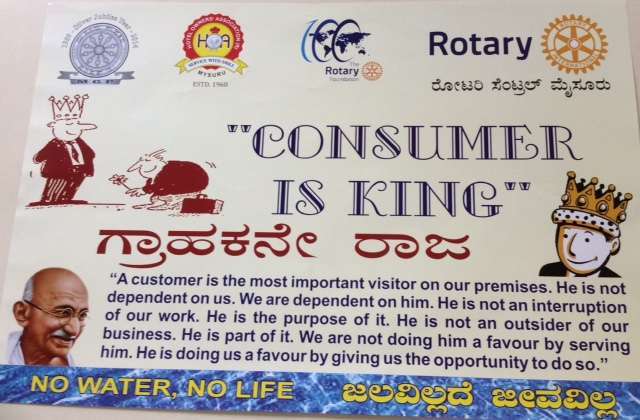
Mysuru is not just another city of the state or the country. It has won awards as the cleanest city and also the first public defecation city. But we need much more to preserve its heritage (will we succeed in constructing Devaraj Market to reflect its beautiful old structure and not another concrete jungle?). Therefore, those Mysoreans interested to save and preserve heritage Mysuru, are requested to contact MGP secretary Dr. M. M. Shenoy (0821 2515150 /94484 82050) to discuss their strategies as well as their involvement. It is only when public at large get involved, Mysore can be saved from going the way of Bengaluru. Dec 18 2016 Consumer Rights and responsibilities to make him a king. Bhamy V. Shenoy December 24th is celebrated as National Consumer day in India. To have maximum and lasting impact MGP has decided to celebrate this event for a week involving every sector of the society. The most important sector is educational institutions and that too schools. In each school, teachers can organize an interactive session with the students on Consumer rights and responsibilities so that students will be able to appreciate how
consumer movement can help in the development process and also how to prevent from taking for a ride by corrupt merchants, incompetent bureaucrats and officials. To help the teachers some suggestions on consumer movement is given. It was Mahatma Gandhi during the freedom struggle, found time to fight for his consumer right when the railways did not provide the minimum comforts he was entitled after he bought a ticket to travel by the third class. If Mahatma could find time to fight for his consumer rights, how can we abdicate our responsibilities to fight for Consumer Rights, The right to the satisfaction of basic needs, safety, to be informed, to choose, to be heard, to redress, consumer education and a healthy and sustainable environment. Indian parliament took a bold decision to enact Consumer Protection Act in 1986 to confer upon the long suffering consumers of India some of the above rights. This is a unique act to promote consumer rights which is not there even in any developed countries. We in India can be rightly proud of this act. Under this act, three level special consumer courts are established; at district, state and national level. Unlike civil courts, cases are to be settled in less than six months. There is no need to employ lawyers and there is no special format to submit complaints. Thus the cost to file a complain in consumer courts has been reduced to a minimum fee of Rs. 100 to prevent consumers from filing frivolous cases. Unfortunately because of poor training of officials serving on these consumer courts, they have become another set of civil courts. If only, we the consumers had not abdicated our responsibilities to demand reform of these courts, we could have prevented this sad state of affairs. Well informed consumer can be a real king if he is prepared to exercise his rights. But he should concern himself not only about his rights, but also about his responsibility as Mahatma Gandhi tried to teach us through his own example. Let us look at some of the following examples. While traveling in a KSRTC bus if a conductor collects Rs 5 for a journey costing Rs 5, should a student demand for the ticket? On the other hand, even if the journey costs Rs 10, and does not give the ticket should a student demand for the ticket? It would be an interesting experiment to find how many demand tickets in both cases and why? To establish one is a consumer, there is a need to secure the ticket. In both the cases, by not securing tickets, consumer indirectly helps the bus staff to defraud the government. Of course in the second case, he also benefits. This is an example of consumer showing his/her responsibility of upholding a simple principle for paying the right amount for the services. This case looks very simple. How many of us complain when the electric meter does not run properly? How many of us complain when water meter stops working?