
[ಕನ್ನಡ ಅನುವಾದ ಶೀಘ್ರದಲ್ಲೇ ಬರಲಿದೆ — Kannada translation coming soon]
Consumer Movement: How can we strengthen it in Mysore? (Part III) The reasons for the failure of consumer movement to take off in Mysore are many and easy to find out based on the experience of Mysore Grahakar Parishat. Some of the reasons of MGP are likely to be applicable for Mysore’s other NGOs. Before analyzing the factors which prevented the take-off, we need to eliminate some myths and long held wisdom. Usually NGOs try to blame the government and politicians for their failure by stating that the government should finance them. One of the reasons for consumer problems is the inability of the government to spend the funds available to it productively (the famous quote of Rajiv Gandhi that for every one rupee spent by the government, only 15 paise reach the ultimate beneficiary). Therefore no consumer NGO should depend upon the handouts from the government for its activities. It has been the experience of MGP that none of its projects have suffered because of lack of funds. It can be argued that if MGP had more funds, it could have hired better lawyers to argue its court cases more strongly. Since MGP wants to depend only on those lawyers who are interested to fight for social causes without charging fees, there is no question of attracting better lawyers by paying higher fees. MGP has failed to motivate more competent lawyers to take up its cause. Therefore that may be the reason for its failure to win more cases or file more PILs and not the lack of access to more funds. MGP cannot blame politicians or elected representatives for its failures. They have shown supreme indifference to consumer movement. In a democracy, political parties and elected representatives have a large role to play. MGP’s goals are to bring about structural reforms which can be achieved only with the help of elected representatives. Therefore MGP should have tried to interact more with them. Just because some of them are corrupt and only after power or many of them are incompetent, it is not a good reason for MGP to keep them out. Despite all the problems and difficulties, MGP should have tried to work with the elected representatives as well as political parties. Today based on the membership of around 700, MGP is likely to be the largest consumer NGO in the city. But the actual number of members who have any time to work on projects may not be more than 20. MGP publishes a monthly called “Grahak Patrike” and sends it to all the members. It is doubtful even 50% of the members read it based on the responses received. Since its inception, MGP must have served more than 10000 residents directly by assisting them to solve their problems. The number of people served indirectly is the entire population of Mysore. It is reasonable to expect that by this time at least 10,000 should have become MGP members. At least 1000 should have been active members of MGP to demand for consumer rights and be actively associated with MGP. In this case also MGP has to take some blame. It failed to develop a secretariat with paid staff. Since MGP had in the beginning few activists who were prepared to work without pay and even to spend their own funds, it did not see the need to appoint a paid staff. Even when it attempted to hire some staff, it did not succeed. For an NGO to succeed, it is not enough just to have a team of part time activists however outstanding they may be. They should also have an equally
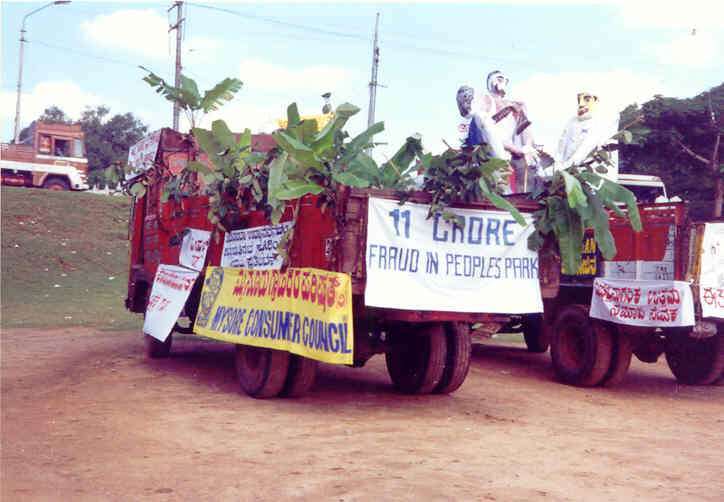
competent staff who are well paid and properly managed. This is one of the reasons for the success of BATF in Bangalore and of a young organization of Mysore Pratham. While pointing out the drawback of MGP and some of the things it could have done better, it should be pointed out that the most significant reason for the failure of consumer movement to take off in Mysore is the total indifference on the part of consumers to take up even the smallest responsibility. There is just no voluntary spirit or a burning desire on the part of Mysoreans to get involved in civic affairs unless they see the immediate benefit for them. Affected by the ill treatment by cable TV operators, Gokulam residents came together in hundreds under the leadership of Baradwaj to fight the mighty monopolistic power of signal providers. They were even prepared to boycott the cable TV to teach a lesson. But how many such activist residents can we see fighting for say to get rid of pigs from our city or to remove the petrol station from Panchavati? When MGP organized a demonstration against lead removal from petrol which will cause mental retardation, there were just five to show their support. To show support to organizers fighting against the illegal building in Cheluvamba Park, even the educated residents living in the apartment facing the park did not think it was their duty. They were mere spectators from their balcony wondering at the “stupidity” or publicity crazy act of the agitators. It is only when MGP and other NGOs succeed in convincing the consumers of the city that it is their civic duty to fight for their rights, consumer movement will succeed. Role of Mysoreans to avert water crisis. (March 25, 2004) It is short of a small miracle that Mysore has so far avoided water crisis. When MATF started to put pressure on the authority during the month of December anticipating water crisis, KRS water level was 78.66 feet versus 93 feet last year. Though it was an alarming situation, we were assured that since KRS has to meet the drinking water needs of Mysore and few smaller cities only, Mysoreans need not worry. We were even ridiculed by many of them that we are unnecessarily creating fear psychosis. In any case drawdown of water till March 19th was only to the level of 74.74 feet. Thus the draw down of four feet of water met the drinking water needs for three months. There was some period during this time, water was supplied for purposes other