
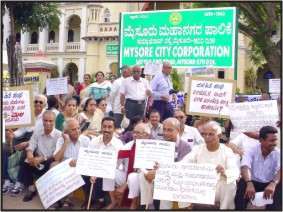
MGP Planning Meeting on Save Mysore Campaign. (July 7 2004) Since Mysore Grahakar Parishat failed to get convincing answers to their complaints from Mysore City Corporation, MGP has decided to launch its protest activities with a peaceful demonstration on July 19 in front of the corporation at 4 PM. It has also planned one lakh signature campaign both to get Mysoreans involved in this protest campaign and to send a strong message to the political leadership that radical reforms need to be implemented at the corporation. Signature campaign is designed to find out how many citizens have lodged complaints with the corporation regarding water and sewege, garbage, SAS, pigs and stray animals, illegal buildings and other civic problems. During the signature campaign, signatories will also be requested to suggest their three top priority problem areas. Thousands of pamphlets will be distributed to educate the citizens on the need to get involved in this campaign to make this a peoples movement. MGP’s protest is not against any individual officers or political leadership. It is against the whole system that we have inherited from the British time. Unfortunately the system has failed to keep up with the new reality. In some respect the protest is against we, the people for having been mute spectators all this time. In a democratic set up, we cannot have that luxury for which we are paying now. The massive operation of securing one lakh signatures will be possible only if citizens come forward in large numbers. MGP has no illusion that just by securing one lakh signatures difficult as it is, or holding a dharna, we will be able to save the city. This is just a beginning. But through consistent pressure and large number of public participation, we can achieve our goals. A planning meeting at 4 PM at MGP office is organized on July 11 to develop the strategy for that purpose. All those interested to save our city from further decline are requested to contact MGP at 2515150. Convener, Save Mysore Campaign Dr. S. A. Prasad. SAVE MYSORE: MGP PLANS ONE LAKH SIGNATURE CAMPAIGN By K.B. Ganapathy Mysore, July 10- The Mysore Grahakara Parishat (MGP) will launch its massive, unprecedented one lakh signature campaign from the tax payers of the city to rouse the conscience of the citizens and to draw the attention of the politicians and bureaucrats to the sad state of affairs in the administration of Mysore City Corporation and other agencies responsible to provide civic amenities. A meeting of the committee members of the MGP to work out the modalities to collect these signatures will be held tomorrow, according to Dr. Bhamy V. Shenoy, a member of MGP. The campaign will, however, be launched formally on Monday the 19th July, 2004, from the City Corporation premises at 4 pm in the presence of some important persons. It is learnt that the test cricketer from Mysore Mr. Javagal Srinath, the renowned litterateur and a well-known social activist Mr. Devanur Mahadev, Mr. Mukund of Janagraha, an NGO from Bangalore, are likely to be present at the launch.
The theme of the campaign is very simple with just two-words: ‘Save Mysore’. Our city, though considered ancient, going by its hoary past claimed as a royal city because this was the capital of Wadiyar dynasty, a city known as a cultural capital because of many distinguished artists — painters, sculptors, writers and musicians of repute and also a city described as the knowledge capital of Karnataka by President Dr. A.P.J. Abdul Kalam, because of the country’s one of the oldest University and a large number of educational and professional institutions located here, it is sad no serious effort has been made by successive governments and the administration to protect the city’s heritage mentioned above. As a result, today we find garbage bins overflowing on almost every road. The city produces on an average 500 tonnes of garbage daily but the Corporation has the facility to remove only 350 tonnes a day. The city roads are also in bad shape without proper cleaning, asphalting, drainage and footpath. Yesterday’s heavy downpour has made this point abundantly clear to all those who ventured out during the rains. Many were stranded because of the clogged and insufficient drainage system that resulted in turning the roads into virtual rivers leading to the breakdown of drainage system in almost all extensions and the downtown area. One wonders whatever happened to the ADB loan with which these works were executed. Probably, the major portion of the taxes we pay are spent on ADB debt servicing. The very fact that in the last six years, the Mysore City Corporation had seen about 10 Commissioners speaks eloquently about the laxity of the administration which makes every Commissioner unaccountable for his acts of commission and omission as well as incompetence, not to speak of mismanagement of funds. It is suspected the Commissioners are often shifted with a purpose by the politicians to ensure that the misappropriation of funds are properly covered and no accountability could be fixed. The Mysore Corporation and the citizens of this city could have emulated the Mangalore City Corporation which refused outright to take ADB loan for the reason that there will be many fingers in the ADB pie and very little of it as a result would be available for actual execution of the work. Look at the way our roads are occupied. There are less number of vehicles and more number of pigs and cattle on the roads. The Jaywalkers occupy half the road and they can not be blamed because there are no footpaths. The roadside vendors are another menace as their customers park their vehicles right on the road. Though the citizen are saddled with this kind of maladministration, the people’s representatives like the Mayor and the Councillors have absolutely no real power to administer the city and their respective wards. The present law provides almost absolute authority only to the Commissioner and it is, therefore, for the Commissioner to exercise his powers effectively, taking into confidence the Mayor and the Corporators, except in cases where these elected representatives support what is illegal and not good for the city — like cattle and pigs on the streets, roadside vendors etc., The signature campaign, it is hoped will put sufficient pressure on the authorities to entrust the administration of the city into the hands of a single central authority. Right now there is a multiplicity of authorities administering our city — like the Corporation, MUDA, Deputy Commissioner, Zilla Panchayat, PWD, KUWS &DB, Vani Vilas Water Works, MESCom (KEB) etc.., — each autonomous and works without co-ordination with the City Corporation. And what about the MATF ? According to some members of the MGP, MATF is no patch on BATF (of Bangalore) and has already discredited itself so much MGP would have nothing to do whatsoever with MATF. It is learnt that the members of MGP, Prajna (NGO set up by Dr. Ajaykumar and Prof. Umapathy) and students with concern for social service would go to houses, shops and factories and collect the signature of the tax payers. We appreciate the clean green environment of Singapore, we admire the efficient workings of the city governments of German and other developed countries. We look with awe at 24 hours water supply in all the cities of the US and streamlined collection
of garbage. Even our Mysore was like that at one time during the times of Maharajas. Why is that we are suffering today when we have democracy and we are the rulers? Under the British Raj, the government was mostly interested in collecting revenues to maintain law and order. Today under our own rule, the government is interested to make use of laws to help bureaucrats and politicians. In utter desperation, MGP is now organising an agitation on July 19 to provide a platform to all the citizens of Mysore to show their frustrations, disappointment and anger towards the establishment. This is only a beginning and MGP will continue to put pressure to reform the system with renewed vigour. But we can succeed only if citizens come forward in large numbers and participate in this people’s movement. Those interested to take part in these efforts should contact MGP at Ph: 2515150. News | Editorial | Voice Of the Reader | Abracadabra PRESS RELEASE (14-7-04) Dr. Bhamy V. Shenoy, Mysore Grahakara Parishat Devaraja Market Restoration: Need for New Approach Every Mysorean would like to preserve the beautiful architecture of Devaraja Market as a heritage building. Towards this end, several meetings have been held by MATF, MAHTF, and MCC with leading citizens of Mysore, tenants of Devaraja Market, officials and political leaders. Many suggestions have been made during these meetings. In my view, most of these suggestions can not be implemented or, even if implemented, they may still not restore Devaraja Market to its previous glory. I am offering some suggestions below, which may serve to develop a new approach for restoring Devaraja Market. Short Term and Long Term Plans Both short term and a long term plans to restore the market are needed. The short term plan should be implemented within a few months and the long term plan may take as long as a few years. The short term plan should deal with things such as regular cleaning of the market, construction of proper toilets, providing enough walking space for customers, enforcement of existing regulations, development of a computer data bank which will give critical information such as names of lease holders, type of business (according to lease agreement), actual current business, rent structure, terms of lease, area of property leased, change of lease ownership, etc. A committee consisting of Devaraja market shop owners, Corporation officers and Corporators should be formed immediately to develop and implement the short term plan on a time bound basis. It is the long term plan that requires new creative thinking. The first step is to form a small steering committee (consisting of persons who have demonstrated business acumen and management expertise) with the Mayor as the chairman and the Commissioner as the secretary. The steering committee in turn should constitute three subcommittees to deal with legal issues, design of a new building, and financial issues. The members of these subcommittees should be
professionals who have demonstrated their excellence and not just someone who has served in government bureaucracies or business organizations. Legal Issues Committee The most critical factor in restoring the market is the resolution of legal rights of the lessees. Unless this issue is resolved, no plans will succeed and Devaraja Market will become another Makkaji Chowka. However this is not an impossible task. There will be all kinds of political pressures to maintain status quo. However by getting top legal advice, we will be able to get a proper handle on the legal issues. Caveats should be obtained so that vested interests can not easily stay the formulated plans. It may even be necessary to ask the government to bring about the necessary legal reforms so that the restoration can proceed smoothly. Design Committee The redesign of Devaraja Market should not be done in isolation, but keeping in mind the development of the city in the next 25-50 years. An integrated plan for the whole centre of the city is necessary. Whether to keep the original Devaraja Market building as it is or to have a new building with modern amenities but the same facade and the same architectural style should be seriously debated by the public of Mysore. The market is not just a monument, but a functioning civic amenity and so should provide facilities such as clean toilets, drinking water, effective lighting, ample cold storage, automatic teller machines, etc. and possibly child care, refreshment kiosks, seats, lockers, etc. The existing building does not offer most of these facilities and the public of Mysore should decide whether they can do without them. Since the real estate on which Devaraja Market is located is one of the costliest in the city, we should also think of increasing the rental area to earn greater revenue to the city. A new building with modern facilities would attract a different kind of business people who are prepared to pay the much higher market value rents thus justifying higher investment. The possibility of buying properties behind Devaraja Market must also be looked into. They can be used to construct a huge parking building for customer vehicles. Today many people are hesitant to come to Devaraja Market and to the city centre in general because of inadequate parking. Assigning the responsibility of developing the property to a nationally renowned companies such as L&T by an open tender may also be looked into. Finance Committee This committee should look at ideas of attracting investment from banks and development agencies. One such idea is for the MCC to form a new company wholly owned by MCC and transferring all Devaraja market related properties to that company. Such a company run by a competent professional management may have a better chance of obtaining loans from financial institutions to restore the market. It will also have far more flexibility in dealing with financial, legal and maintenance problems. Today MCC is able to get only about Rs. 27 lakhs as rent annually for the whole Devaraja Market building and is spending about Rs. 20 lakhs a year to maintain it. So the net revenue generated is almost nothing. If professionally managed, the building should be able to earn several crores of rupees every year.
Many of the original lessees are making huge profits by subleasing their shops at market rates while paying MCC just a pittance. It is ironical that such merchants are now requesting the government and other donors to finance the restoration. It is highly unlikely that the philanthropists will fall for this ploy even in the guise of preserving heritage. It is a pity that our government which has no funds for worthier and more urgently needed causes is thinking seriously about subsidizing the merchants when with some creative financial engineering there is no need for such a subsidy at all. What we need today is imagination and not old worn-out methods. There is no disagreement about restoring the old glory of Devaraja Market. But how to go about it calls for better managerial and administrative abilities than we have seen till now. Citizens of Mysore, Arise and Awake to Save Mysore. (July 20, 2004) An appeal to celebrate Independence Day in a different way this year. The silent protest demonstration in front of Mysore City Corporation on July 19th clearly showed that residents are now ready to come together on a single platform to put pressure on the system to bring about radical reform. The one lakh signature campaign is also gaining momentum in all different wards of the city. The long list of our problems dealing with water and sewage, pigs and stray animals, roads, property taxes, building code violations, food adulteration is getting even longer as more sign the petition. Let us not have any illusion that just these two activities will begin to solve our problem. This is only a small beginning. Our road to reach the goal of saving Mysore is long. Obstacles are many. But by uniting in thousands, we will certainly succeed. We need to continue to work on getting more signatures. In addition to this activity we need to take some more initiatives. One such initiative is to celebrate Independence Day differently this year. First of all let us not take part in any Independence Day celebrations organized by the government to show our anguish. Actually what do we have to celebrate? For example, children living in slums and poor neighbourhood do not have access to proper schooling even after 57 years of Independence. More than 45% of children in government schools cannot read a sentence even after being there for as many as 6 to 7 years. Why do we have the tamasha of fighting seat allocation for professionals colleges every year just when admission process starts? Is it such a difficult thing to solve? In every year school and college, while celebrating Independence Day, instead of talking only on our freedom struggle and the sacrifice made by freedom fighters, the chief guests should discuss how their dreams have been shattered in Mysore and what we in individual capacities should do to save Mysore. There is no use of just blaming the system or the politicians or the bureaucrats. We are as much to blame as any one else because we have allowed that either by action or inaction. It is true that some of us have protested, given repeated petitions, filed court cases, even voted against the corrupt leaders and nothing has happened. This is because there was no critical mass. However if we keep up the momentum of Save Mysore campaign and start recruiting more volunteers, we will soon reach the critical mass. Then no force or vested interest will be able to stop the reform we want.
To celebrate Independence day, owners of houses on important streets of the city should erect banners with the picture of the national flag, Save Mysore logo along with one significant problem they want the city to solve. When hundreds of such banners all over the city stare at pedestrians every day, no responsible political system dare ignore them. Those banners will also awaken the awareness amongst the residents to get involved. Those concerned residents who are interested to take part in this heroic struggle are requested to contact MGP at 2515150. Let us not be just mute spectators. Instead by coming together let us save Mysore from further decline. SOM coverage of Save Mysore (July 20 2004) Mysore, July 20 (BRS&RR)- The ‘Save Mysore’ campaign staged yesterday in front of the Mysore City Corporation here under the auspices of Mysore Grahakara Parishat (MGP), drawing hundreds of citizens, including women and school-going children, was a grand success. The signature campaign of the MGP to draw the attention of the State Government as well as the civic body on the need for taking urgent steps for saving Mysore City, received spontaneous support with more than 600 citizens affixing their signatures yesterday alone at the venue. The dharna staged yesterday is seen only as a first step, with all indications that it will be intensified as days pass. Clarion call A large multi-coloured banner written in Kannada which gave a clarion call, “Citizens of Mysore, arise, wake up, save the city from the disasters enumerated hereunder; save it, let us live” was prominently displayed, attracting the passersby. The disasters The banners listed the following disasters of the city: The roads that have lost their shape completely, misuse of public places, the burden of house property tax according to Self Assessment Scheme, inefficiency in managing the city’s vehicular traffic, encroached footpaths,
the serious problem of drinking water shortage. The above are only the selected problems bugging the citizens of Mysore, MGP proclaimed. The problem of drinking water in the city, tauntingly presented by the organisers of the stir, lent a sense of humour, challenging the inefficiency of the Department of Health in the Corporation. The project titled ‘Nirmala Yojane’ in Kannada, was split as ‘Neeru-Mala’ Yojane. In Kannada, ‘Mala’ is filth. The copious flow of water out of the drains following rains in the city was meaningfully compared to the free flow of currency lining the pockets of officials. The helplessness of the Commissioner of the Corporation was reflected in these lines, in the hand-outs distributed on the occasion: The Commissioner says ‘what shall I do, pigs are roaming about in my own backyard ? You are warned, the pigs may take over your homes too…’ These lines served to hold mirror to the omnipresence of filth and sewage in addition to the unchecked presence of unsightly pigs in residential areas of the city, about which the Corporation officials have turned their blind eyes. Responsibilities Another hand-out of the MGP had a telling message to the citizens, reminding them about their forgotten responsibilities to ensure clean and transparent governance by the Corporation. Many hand-outs, thoughtfully written in order to make the citizens aware of their role in saving the city as well as the duty of the Corporation in ensuring it, were all over the venue even as the papers were held high by the senior citizens, who were present in large numbers. Honest and selfless The citizenry who spared their efforts and time of the afternoon in coming over to the venue of the stir, for expressing their deep concern about protecting the city with all its beauty, culture and heritage for posterity in an honest, selfless and disciplined show by taking their position on the edge of the road, neither disturbing anybody nor raising slogans, attracted the attention of thousands of passersby, who were full of appreciation for their efforts. The public were seen eagerly coming forward to affix their signatures, and also taking part in the stir for a while before making way for more people. The participants Akhila Bharatha Grahaka Panchayat, International Human Development and Alleviation Organisation, Mysore Lok Swaraj Andolan, Gokulam Welfare Association, Prajna Praja Prabhutva Jana Andolan, Janahita Sangha, Mysore Citizens Forum, Adarsha Auto Sangha and many other voluntary organisations lent support to the movement by being present in large numbers at the venue of the stir. The movement also brought to the venue some members of the Mysore Agenda Task Force, apart from representatives of the Bajrang Dal. The personalities who have made clear their unequivocal demand for action by the authorities concerned to save Mysore City from destruction and deterioration through their writings and
who were present at the venue included: Prof. G.T. Narayan Rao, Mr. T.S. Satyan, Dr. Bhamy V. Shenoy, Mr. B.V. Shenoy, Mr. H.R. Bapu Satyanarayana, Dr. H.A.B. Parpia, Mr. R. Vasudevamurthy, Mr. V. Siddharthacharry, Prof. Kalachannegowda, Mr. R.S. Venkatesan, Mrs. Mangala Satyan, Mrs. Madhuri Thathachari, Mrs. H.R. Leelavathi, Prof. S.K. Anandathirtha, Dr. Dayanand Patel, Dr. Srinivas, Mr. M. Lakshmana, Dr. Prasad, Mr. A. Vittalamurthy, Mrs. Chikkamma Basavaraju, Mr. R. Anantharamu, Mr. P.J. Bharadwaj, Mr. N. Suresh, Prof. Shekhar and hundreds of others. In the backdrop of the silent and disciplined manner of the stir for about an hour from 4 pm which did not disturb either traffic or life of citizens, the Police did not have to do much at the venue except for some minimal supervision of vehicular movement. What should mayor do to collect taxes more effectively? (Aug 4, 2004) Dr. Bhamy V. Shenoy Every responsible resident of Mysore should pay his or her share of the property taxes to the corporation. This goes without saying. Without such revenues, the corporation cannot carry on with its responsibilities of meeting our civic needs. However such taxes should be equitable. Citizens should also perceive them to be equitable. To the extent possible, there should be no discretion left to the officers of the corporation to estimate such taxes. Special cases of pensioners, widowers, physically challenged, and senior citizens should be taken into consideration while formulating the regulations. When such a system is adapted, the corporation should take care to implement it properly like having an independent auditor to monitor the tax assessment and punitive penalty for offenders. It is indeed unfortunate that our corporation has implemented an excellent idea of SAS in the most dreadful way. Potential property tax revenue is easily more than Rs. 30 crores per year and the budgeted amount to be collected for 2003 was just Rs 10 crores. How can this be equitable? The system in force to collect taxes is even more cumbersome and most citizen-unfriendly. It was Mysore Grahakar Parishat that had developed and promoted the idea of SAS few years back. But MCC has failed to implement the basic philosophy behind MGP’s suggestions in every respect. When any system, even the simplest one is revised, it is the responsibility of the officers to educate the public on the changes and also to sell them on the need for such changes. MATF’s Arun Raman with his team came forward to assist our corporation. He spent his own money to develop a computer based system. What a shame, because of frequent changes in commissioners (it is not accidental and completely intentional), and indifference shown to his ideas, MCC failed to make use of his expertise. When tax payers go to pay the property taxes, they are received with utmost discourtesy as though he is committing a crime by going there. Since the procedure though simple is new to many and the corporation should have developed a system to help citizens. That is not the only problem a tax payer faces. It is only the beginning. The tax form is intimidating and not easy to follow. An illustrative example of computing the taxes of typical house if attached to the form
could have been helpful. The offices do not carry even booklets explaining the procedure. Is it too much to ask for such booklets? Why has not MCC streamlined the process of collecting taxes. What a complicated system we have today! The first step is to go the office and get the tax form approved or get it filled. If the officer concerned is not there, or the tax payer has not brought all the needed information, then one has to make another trip. Once the tax form has been prepared, four sets of chalans have to be filled, and the tax payer has to go in search of the State Bank of Mysore branch. Other banks cannot receive money. After the money has been paid to the bank, the tax payer has to come back to tax office to give one of the chalans, tax form and get it stamped. If MCC is really interested in being tax-payer friendly, they could have avoided many of these steps, and would have devised a system to avoid unnecessary trips and frustration. In addition to all these problems, the tax payer is asked to xerox old receipts and attach to tax forms to ensure he has paid all his back taxes. The information system that MCC continues to depend upon to find out about the tax arrears was the one which must have been developed some decades back. It is indeed a crying shame that when we have some of the brightest CAs and world-class software companies in Mysore, our corporation has failed to make use of their expertise to develop the much needed Management information System to monitor tax payments. Today it is not easy for MCC to generate any kind of report to find out how much taxes are collected from each ward, the amount of arrears by years, the largest tax offenders, the amount of penalty that can be collected etc.. In other words, the current information system is totally incapable of generating any useful reports to hold any one accountable. Any good management will insist on having such reports. Is this intentional or accidental? The mayor has requested MGP to assist the corporation to improve tax collection. MGP fully apprecaites that without revenues, the corporation cannot function. But, MGP also needs some help from mayor. Will he streamline the entire tax system? Will he ask the corporation to educate the public on new SAS? Will he also implement a system to collect from thousands of rich and connected and also from the vacant sites? To begin with, the mayor to publish a list of all the mayors and corporators former and current, who have paid taxes during the last five years. If this list is long, he can publish a short list of those who have not paid. Can mayor also ask the commissioner to repair all the road cuttings for which money has been collected? Can mayor give us information on what the corporation has done with all the funds collected as education cess during the last five years. How much tax has been collected from the owners of thousands of vacant sites? This may look like a long list. It is not. All that is sugested is simply to follow the rule of law. Is that asking too much? PERFORMANCE ASSESSMENT OF CIVIL SERVANTS BY MYSOREANS. (Aug 12 , 2004) In any democracy, citizens are the real masters and government officials however high they may be are their servants. Since we are the paymasters, we also have the responsibility to assess the performance of those who work for us. It is true that there is a buil- in system of providing confidential reports on the performance of our civil servants. It does not need a deep study to
conclude that the system has totally failed in terms of providing a meaningful performance assessment. Starting this year, MGP wants to involve the residents of Mysore in assessing the performance of the five top civil servants whose combined or individual decisions affect the future of Mysore. They are: 1. Commissioner of Mysore City Corporation, Sri. Ibrahim, 2. Commissioner of Mysore Urban Development Authority, Sri Pandey, 3. Deputy Commissioner, Sri Kumar Naik, 4. Chief Executive officer Zilla Panchayat, Sri. Niranjan, and 5. Police Commissioner, Sri. Bipin Gopalkrishna. Hundreds of residents have interacted either directly with these officials or indirectly though their offices. Only those who have the first hand experience of dealing with them are eligible to participate in this survey. MGP requests all the eligible residents to assess the performance of these officials, rate them on a scale of 0 to 10 ( 0 being the lowest performance indicating total failure and 10 indicating the excellent performance) explaining the rationale for their assessment giving concrete examples. Only those entries with the concrete examples will be considered. Since performance assessment is a serious exercise with far reaching impact, MGP requests residents to take the survey very seriously. One may question the usefulness of a survey like this by stating nothing will come out. If every one thinks pessimistically then it would indeed turn out to be useless. On the other hand if most people look at it optimistically, and take some time to put their thoughts on paper, the survey can make a good beginning and we can set the example for other cities. MGP has constituted an assessment committee consisting of Dr. H. A. B. Parpia, the former director of CFTRI as a coordinator with Mrs. Shahanaz Irani, Correspondent of Rotary School, Mr. Sathyen, the noted photo journalist, Mr. Narendra Shah, past President of Rotary West, and Maj. Gen S. Vombotkere to arrive at over all rating based on the input sent to MGP by Mysoreans. Ratings should be submitted to MGP, 6/1 Vivekananda Road, Yadavagiri, Mysore -20 ( for more information call 2515150) by not later than August 31st. Irresponsible and untimely transfer of Sri Pandey, MUDA Commissioner (Aug 16, 2004) It is true that an officer can be transferred at the whim and fancy of the government. However when the voters are vigilant and question the rationale of untimely and irresponsive transfer, the government has to listen to the citizens. Today we have such a transfer in our city. Since there is no time for us to write letters and get the reply from the concerned authorities, Mysore Grahakar Parishat is demanding from the government through the print media an explanation for the transfer of Sri. Pandey. Of the several commissioners that MUDA had in the recent years, Sri. Pandey had showed a real concern to streamline the system so that citizens are served on time with no hassle and the need for bribing the babus in MUDA is reduced. In fact just last week, he had invited MGP to give feedback on several forms he had designed to cut down the bureaucracy in issuing Khata, transfer and other documents. He was in a hurry to get our feedback since he wanted to bring
about the reform on a war footing. To improve the general productivity at MUDA, he had restricted the entry of general only to few hours. He had asked MGP to provide a list of all the illegal civic site buildings in Mysore which were violating the original conditions under which they were awarded. No past commissioner had dared take such a bold stand. He had initiated action against some and he was going after some. To be expected vested interests must have complained to the Deputy Commissioner and demanded him to transfer Sri. Pandey. Otherwise we can think of no reason for his untimely transfer where he has not served just over a year. In a democracy like ours where vote banks are controlled by few, we have a new kind of feudal system. The new palegars are who deliver the votes to MLAs and MPs are able to exploit the system. It is to fight against such day light robberies, MGP had conceived of Save Mysore campaign. With our campaign gaining momentum, we want to put countervailing pressure on the system to take back the transfer of Sri. Pandey. During our continuing efforts of collecting one lakh signature, we will educate the public on how the political leaders punish the good and daring officers and reward the corrupt. At the center, the Prime Minister is giving Independence Day speech exhorting the bureaucracy to improve the governance and at the state chief minister is criticizing unnecessary transfers. But our deputy chief minister to control vote banks is taking recourse to transfer an honest, dedicated and daring officer like Sri. Pandey. Can there be a worst damnable crime in democracy? A CRITICAL ANALYSIS OF MCC’s BUDGTING PROCESS (Aug 2004) Dr. Bhamy V. Shenoy, Mysore Grahakar Parishat
The MCC budget for 2004-05 was approved by the Standing Committee on Finance as far back as 19th February, 2004. But the general public got a copy of it only in the first week of August. When we took a critical look at the budget report, it was almost impossible to get an insight into the workings of the corporation. The most basic steps to prepare the budget are ignored. A businessman with high school education could have done a better job. All the budget does is meet the legal requirement of a “surplus budget” by concocting some revenue and expenditure numbers. The “surplus” is a farce since it is arrived at by including loans and advances as revenues! This article is written with the hope that our Corporation would make a radical change in its approach next year by involving the experts in preparing the budget. Perhaps MATF may consider assisting the Corporation. Any budget should separate out capital from the expenditure items which are required to manage the minimum or non discretionary needs of the Corporation. Such is not the case with MCC’s budget. MCC should separate accounts for such major items like water supply, sewerage and sanitation including garbage collection, property tax collection, management of Corporation owned properties, road maintenance, health maintenance, maintenance of parks, etc. In other words, we need to prepare a budget based on major cost or revenue centres so that a proper analysis can be conducted. Based on today’s budgeting system it is impossible to find out the loss or profit of Vani Vilasa Water Works. MCC does not even know the cost of supplying 1000 litres of water. How is it possible for MCC to take the correct decision in improving water
supply? Does it know how much net revenues it collects from its owned properties after taking into consideration maintenance cost? Street lighting (Rs 3.30 crores) and VVWW related costs (Rs. 9.00 Crores) are reported under the category “OFFICE EXPENSES”! Even after taking many months to publish the budget report supposedly to avoid mistakes, the actual expenditure for VV Water works is reported as Rs 1.3 crores and for street lighting as 13.49 crores! It is inconceivable that annual cost for street lighting which was around Rs 1 crore in 2002-03 has jumped to Rs 3.3 crores. How did this escape the attention of the six Corporators directly involved in the preparation of the budget? The actual revenues from the Completion of Reports for 2002-03 was only Rs. 11.58 lakhs. It is projected to jump to Rs 1.15 crores in 2003-04 and then to Rs 2.00 crores in 2004-05. Are these realistic assumptions? Similar assumptions have been made for income from building licenses. The most startling item is the amount of fines collected for building code violations. When the amount collected from CR and building license fees for 2002-03 were Rs. 11.58 lakhs and Rs. 14.20 lakhs respectively, the total fine imposed was a staggering amount of Rs. 1.43 crores. This clearly cries out for an urgent need to take a look at the whole question of monitoring the issuance of building license, and CRs. Is any one at MCC concerned about this critical issue which will have an impact on the future of Mysore as a heritage city? There are many such items popping out of the MCC budget. A cursory look at the property tax shows the poor collection rates. Average property tax on houses increased from Rs. 330 in 1997-98 to Rs. 455 in 2002-03 and has not kept up with the inflation. Even assuming that 50% houses may not attract any property tax, the per dwelling property tax of Rs 455 shows the inefficiency of the Corporation. Even based on a very conservative basis, MCC should be able to collect at least Rs 30 crores per year but it could collect only Rs 8 crores in 2002-03. There is an appreciable increase in per capita spending from Rs. 372 in 1998-99 to Rs 842 in 2004-05. But Mysore’s per capita spending is less than 50% the per capita spending for Bangalore. Not only does Mysore have to find more resources by improving property tax, trading licensee fee collections and rent assessments from MCC owned properties, it should also improve the general productivity of its personnel. MCC’s budget process does not lend itself to carry out any of this type of elementary analysis. This brief analysis shows clearly that MCC’s budget process is a disaster and it needs to take steps on a war footing to reform it. But will it? It seems that only when some international financial institutions such as the World Bank or ADB insist, MCC will implement the needed reform. Let us not wait for them. We Mysoreans should insist on our elected representatives to reform the budget process. Mysore, August, 20, 2004 To Mr. Man Mohan Singh, Prime Minister of India, New Delhi.